What Artificial Intelligence Can and Cannot Do: A Human-Centered Perspective

Introduction: Why Artificial Intelligence Is Often Misunderstood—and Why Its Limits Matter
Artificial intelligence is everywhere in modern conversations. It is described as transformative, disruptive, and sometimes even dangerous. Headlines alternate between promising unprecedented efficiency and warning of widespread job loss or loss of human control. In this environment, it is not surprising that many people feel uncertain about what artificial intelligence actually is—and what it is not.
The core problem is not that AI is advancing too quickly. The real issue is that AI is often discussed without context, nuance, or historical grounding. Artificial intelligence is frequently portrayed as either a magical solution or an existential threat. Both views are misleading.
Understanding what artificial intelligence can and cannot do is essential for individuals, professionals, and business leaders. Overestimating AI leads to poor decisions, misplaced trust, and ethical risks. Underestimating it can cause missed opportunities and resistance to useful tools. A balanced, human-centered perspective allows people to use AI responsibly—without fear, hype, or unrealistic expectations.
This article builds on the foundations explored in “History and Evolution of Artificial Intelligence: From Early Ideas to the Modern AI Era”, which examined how AI developed over time and why today’s systems work the way they do. Here, the focus is narrower and more practical: clearly explaining AI’s real capabilities, its limitations, and why human judgment remains essential in any meaningful use of technology.
What Artificial Intelligence Is Good At
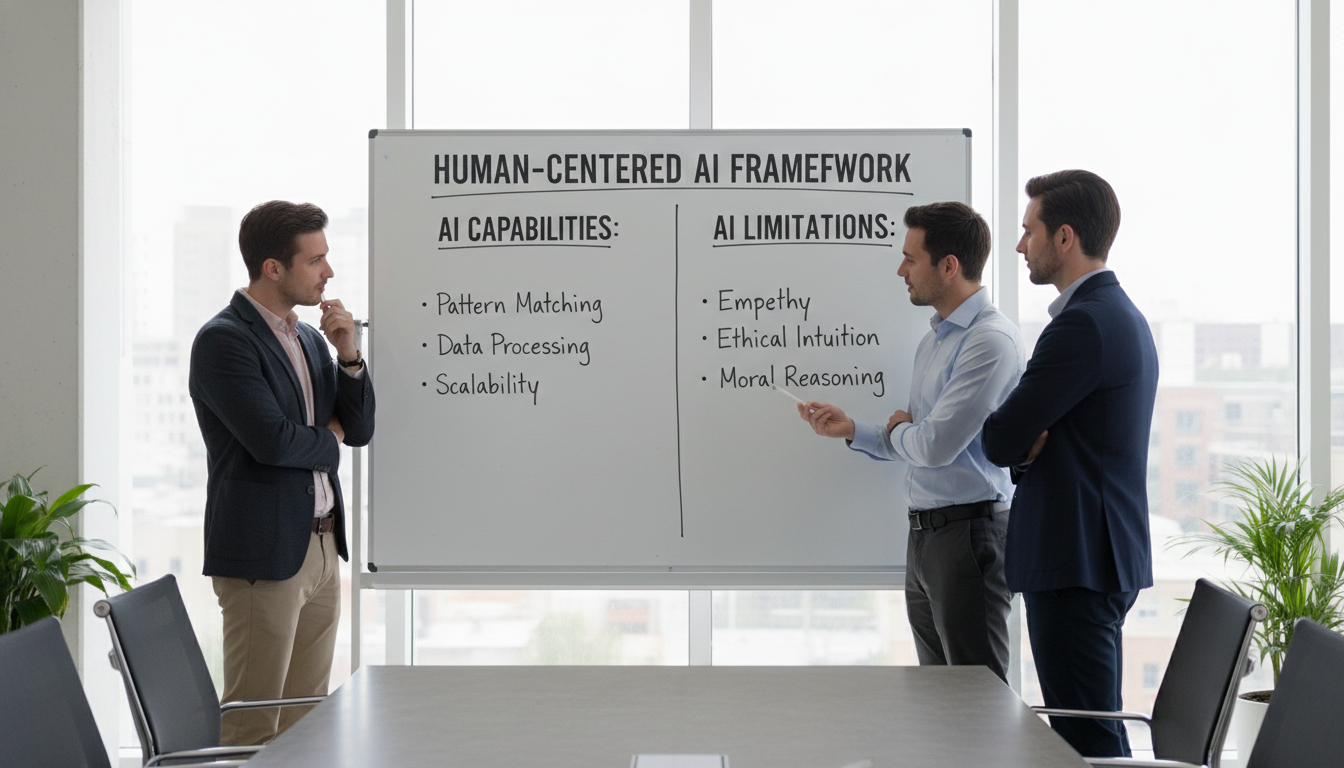
Artificial intelligence excels in specific, well-defined areas. These strengths are technical, measurable, and dependent on data and structure. When used appropriately, they can significantly improve efficiency and accuracy. When misunderstood, they can create false confidence.
Pattern Recognition at Scale
One of the strongest capabilities of artificial intelligence is pattern recognition. AI systems can analyze vast amounts of data and detect patterns that would be difficult or time-consuming for humans to identify. This includes recognizing trends in financial data, identifying objects in images, detecting anomalies in network traffic, or finding correlations in medical records.
Unlike humans, AI does not get tired or overwhelmed by volume. It can process millions of data points consistently. However, it is important to note that AI does not understand these patterns—it statistically identifies them based on past data. The meaning and relevance of those patterns still require human interpretation.
Automation of Repetitive Tasks
Artificial intelligence is particularly effective at automating repetitive, rule-based tasks. This includes scheduling, data entry, document classification, basic customer support routing, and quality checks in manufacturing environments.
Automation reduces human workload and allows people to focus on tasks that require judgment, creativity, and interpersonal skills. When designed responsibly, AI-driven automation supports human productivity rather than replacing human roles entirely.
Data Processing and Analysis
AI systems can quickly process large datasets and produce summaries, forecasts, or probability-based recommendations. This capability is especially useful in fields such as logistics, finance, research, and operations planning.
However, AI outputs are only as reliable as the data and assumptions behind them. AI does not question whether data is appropriate, biased, outdated, or incomplete. That responsibility remains firmly with humans.
What Artificial Intelligence Cannot Do
Despite impressive capabilities, artificial intelligence has clear and important limitations. Understanding these limitations is essential for safe, ethical, and effective use.
True Understanding and Meaning
AI does not understand information the way humans do. It does not comprehend meaning, intent, or context in a human sense. It processes symbols, patterns, and probabilities—not experiences or concepts.
For example, an AI system can generate text that appears thoughtful or empathetic, but it does not feel empathy or understand human emotions. It predicts which words are likely to come next based on training data. This distinction is critical when AI is used in sensitive areas such as healthcare, education, or mental health support.
Intuition and Judgment
Human intuition is shaped by lived experience, cultural understanding, moral reasoning, and emotional awareness. AI does not possess intuition. It cannot make value-based judgments or weigh competing human priorities without explicit human guidance.
In complex or ambiguous situations—especially those involving people—human judgment remains irreplaceable. AI can support decisions, but it cannot be responsible for them.
Ethics and Moral Responsibility
Artificial intelligence has no ethical framework of its own. It does not understand right and wrong. Ethical behavior in AI systems is entirely dependent on human choices: how systems are designed, what data is used, and how outputs are applied.
This is why discussions about AI ethics, accountability, and governance are not optional. They are fundamental to any human-centered AI approach.
True Creativity
AI can generate content that resembles creative work, but it does not create in the human sense. Human creativity is driven by intention, emotion, cultural context, and personal experience. AI recombines existing patterns; it does not originate ideas with purpose or meaning.
Why Human Judgment Still Matters
As artificial intelligence becomes more integrated into decision-making processes, the role of human judgment becomes more—not less—important.
Decision-Making and Accountability
AI can provide recommendations, predictions, or rankings, but it cannot be accountable for outcomes. When decisions affect people’s lives, finances, health, or rights, responsibility must rest with humans.
Human oversight ensures that decisions are explainable, contestable, and aligned with societal values. Without this oversight, AI systems risk becoming opaque tools that obscure responsibility rather than support it.
Context and Nuance
Humans understand context. They recognize exceptions, cultural differences, and emotional cues. AI systems operate within predefined parameters and struggle when situations fall outside their training data.
This is particularly relevant in leadership, management, law, and public policy—domains where nuance matters more than optimization.
Ethical Reasoning
Ethical reasoning requires reflection, empathy, and an understanding of human impact. AI cannot weigh moral trade-offs or consider long-term societal consequences without human direction.
A human-centered AI approach places ethical responsibility where it belongs: with people.
Common Misconceptions About Artificial Intelligence
Misunderstandings about AI often lead to unnecessary fear or unrealistic expectations. Clarifying these misconceptions helps build trust and informed decision-making.
AI Thinks Like Humans
AI does not think. It processes data. Any appearance of human-like reasoning is a result of statistical modeling, not consciousness or awareness.
AI Is Objective and Neutral
AI systems reflect the data they are trained on. If data contains bias, AI will reproduce or amplify it. Neutrality is not automatic—it requires deliberate design and continuous evaluation.
AI Will Replace Most Human Jobs
AI changes how work is done, but it does not eliminate the need for human skills. History shows that technology reshapes roles rather than erasing human contribution entirely. New responsibilities emerge around oversight, strategy, creativity, and human interaction.
AI as a Support Tool, Not a Replacement
A realistic view of artificial intelligence recognizes it as a support system. Humans define goals, values, and constraints. AI assists by handling scale, speed, and complexity.
This partnership model—often referred to as human-centered AI—ensures that technology enhances human capability rather than undermining it. Humans lead. AI assists.
This perspective aligns with the broader historical understanding of AI development discussed in the earlier article on the history and evolution of artificial intelligence, reinforcing the idea that AI has always been shaped by human intent and limitations.
Practical Takeaways for Businesses and Individuals
For businesses and individuals exploring AI, several practical principles apply:
- Use AI to support decisions, not replace responsibility
- Question data sources and assumptions
- Maintain human oversight in high-impact areas
- Avoid using AI where human trust and empathy are central
- Invest in understanding AI limitations, not just capabilities
AI adoption should be deliberate, transparent, and aligned with human values—not driven by pressure or fear of missing out.
Conclusion: A Human-First Perspective on Artificial Intelligence
Artificial intelligence is a powerful tool, but it is not an independent intelligence competing with humans. It is a human-created system designed to assist with specific tasks under defined conditions.
Understanding what AI can and cannot do allows individuals and organizations to use it responsibly. It prevents overreliance, reduces risk, and reinforces the importance of human judgment, ethics, and accountability.
A human-first approach to AI does not resist technology. It guides it. By keeping humans at the center of decision-making, artificial intelligence can serve as a meaningful support—enhancing human capability without replacing human responsibility.